
The Hidden Layer
How a Left Hand jacket made military logic visible.
Republished as originally written. References to events reflect the original publication date.
It has the outline of a bomber, the memory of a liner, and the conviction of something designed to be functional before it is admired.
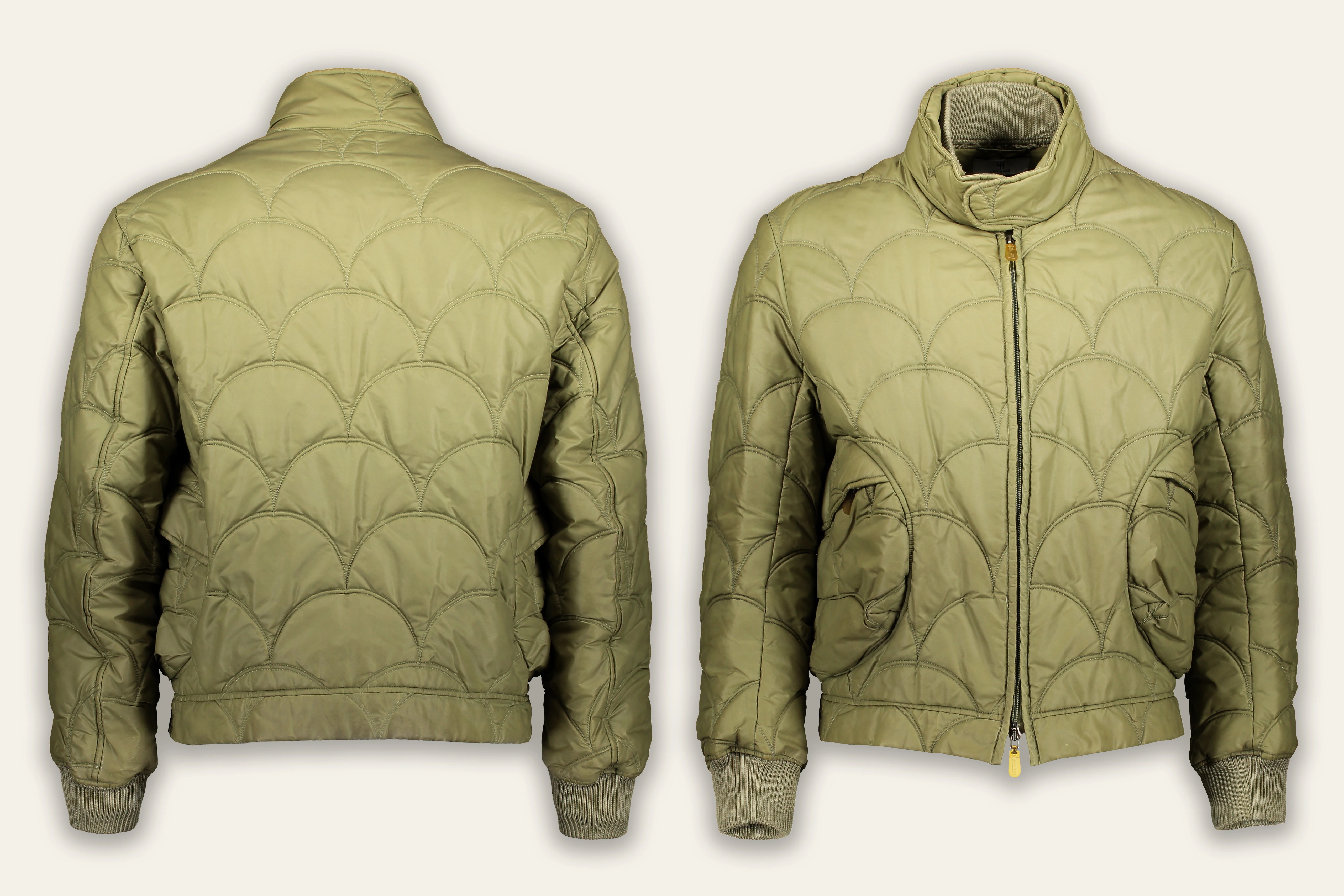
At first glance, this quilted green jacket does not look like the kind of object designers would keep returning to. It has none of the immediate force of a runway look, a technical icon, or a recognised menswear grail. Yet it has become one of the garments most studied by industry visitors to the Westminster Menswear Archive.
The jacket is by Left Hand, the label founded by Massimo Osti in 1993. It has a quilted shell, a central double-ended zip with transparent amber rubber pulls, ribbed cuffs and large circular pockets. It is recognisably connected to flight clothing. Its clearest military reference is the liner: the hidden insulating layer designed to sit inside a larger clothing system.
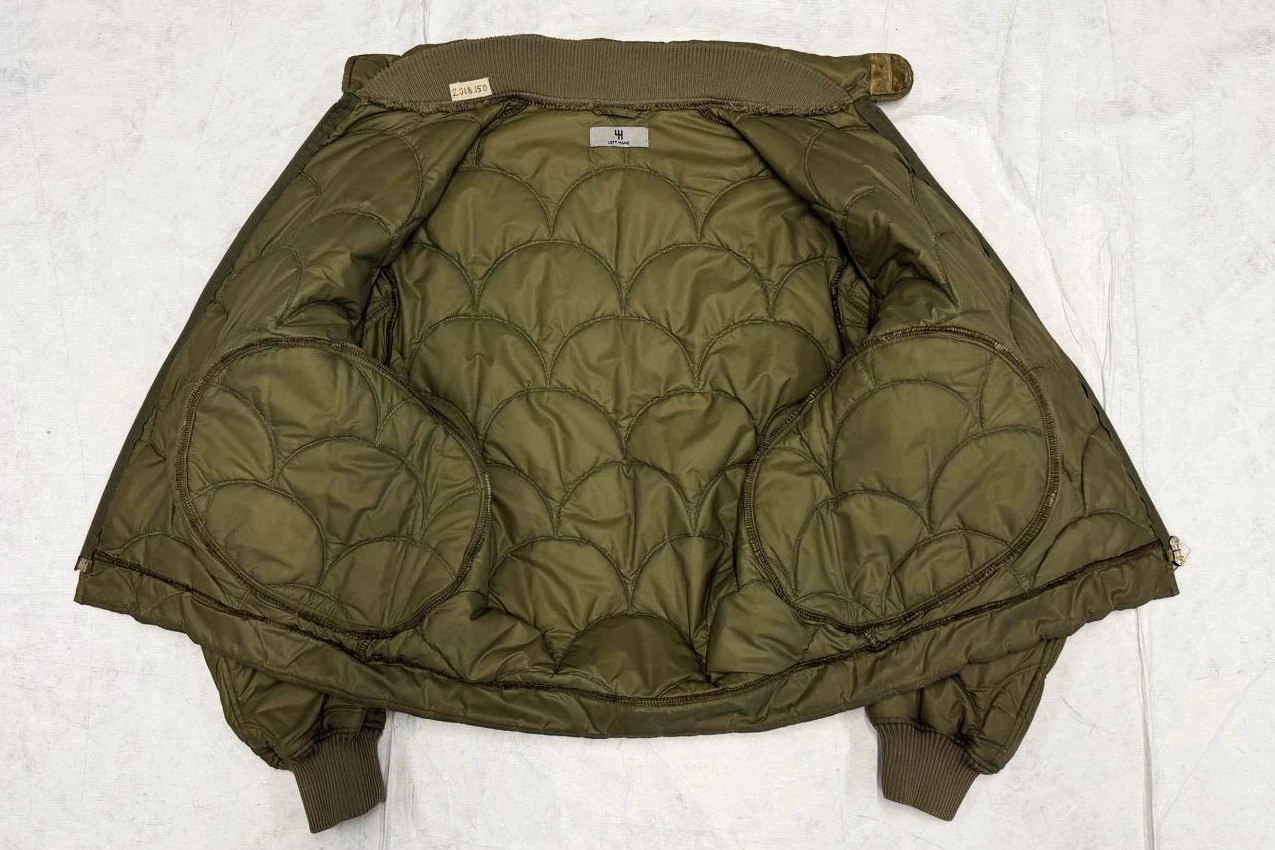
The archive catalogue records that the jacket was bought on eBay on 12 May 2018 for £115, the same day the archive acquired a 1998 Helmut Lang denim jacket. On paper, the Helmut Lang is easier to place: it has a clear date, a recognisable designer, and an established position in late twentieth-century fashion history. The Left Hand jacket is harder to read. We do not yet know its exact year of manufacture, and its significance is less tied to a single date than to a method of working. That does not make it less important. It means it has to be understood through a method rather than a moment.
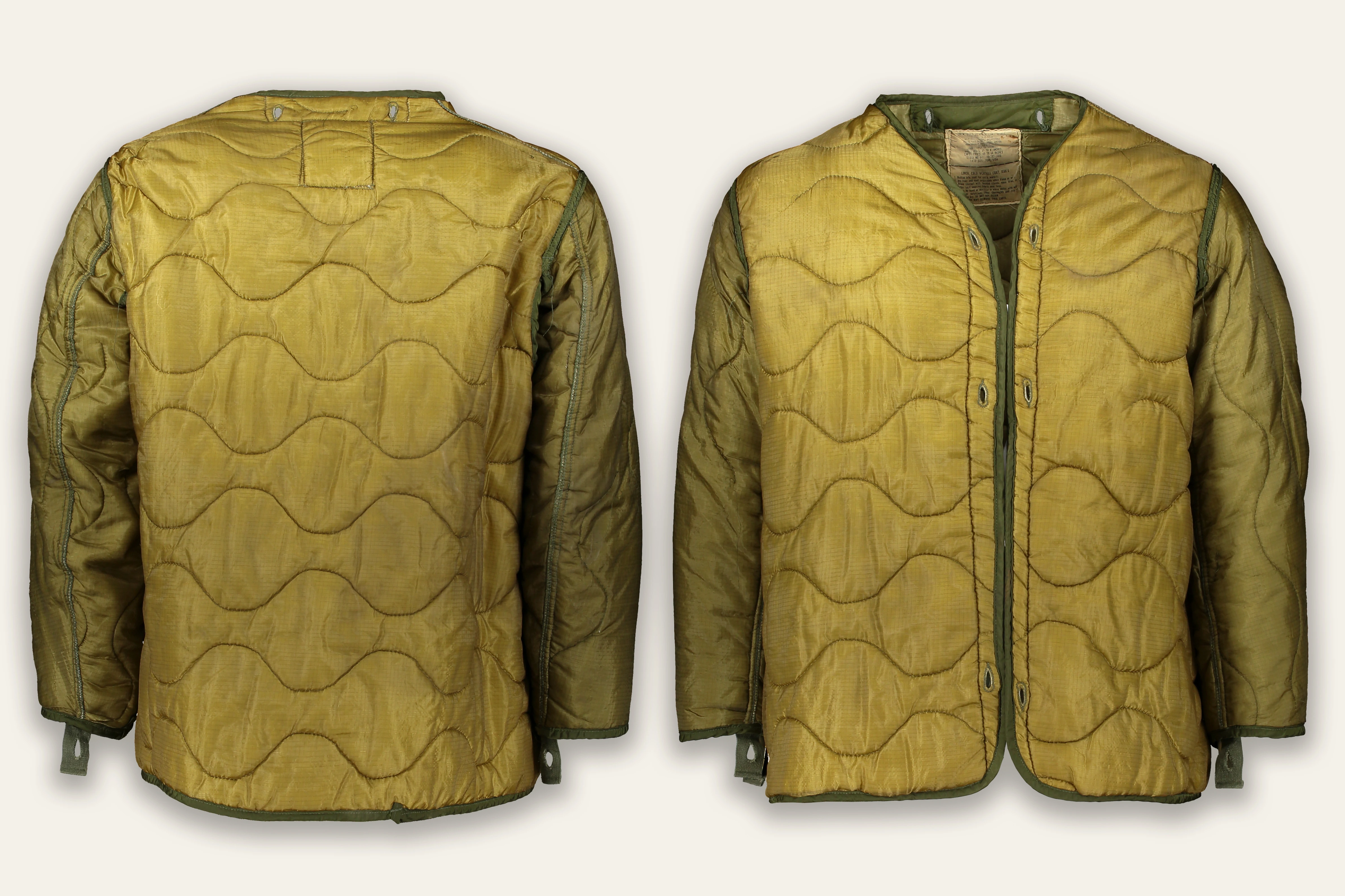
The archive makes that reading possible because it also holds the kinds of garments that make the jacket legible, including a U.S. Air Force Vietnam CWU-9/P quilted jacket liner and a U.S. military M65 cold weather jacket liner.
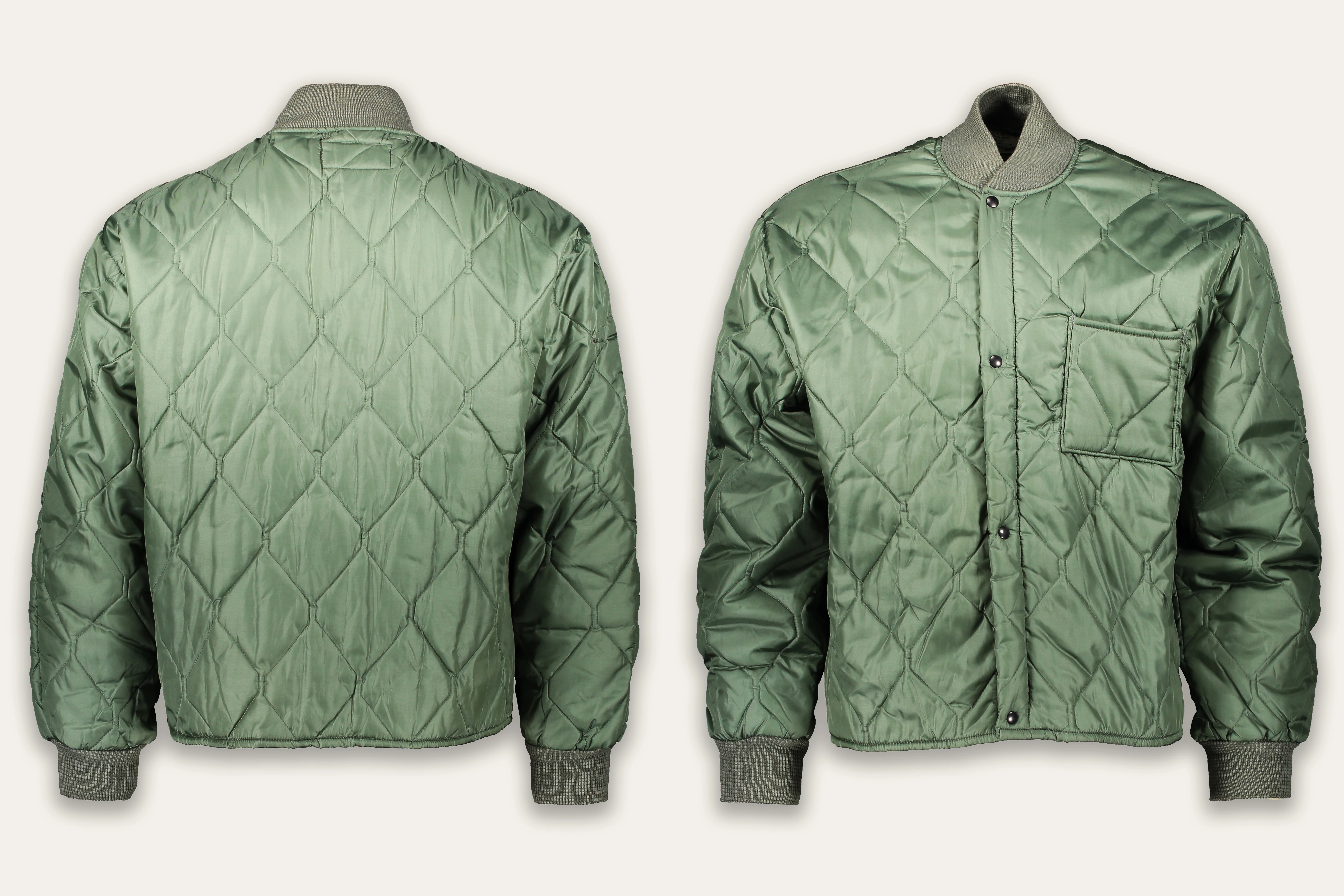
Placed beside them, the Left Hand jacket reads as a reworking of military liner logic. The military liner was designed to disappear inside another garment. Left Hand reverses that condition. The underlayer becomes the outer garment; insulation becomes surface; quilting becomes decoration; pockets become inflated and sculptural. What was once hidden inside a clothing system becomes complete in itself.
Osti’s work often operated through this kind of transformation. Existing garments were treated less as nostalgic references than as working systems to be studied, altered and reactivated. Military clothing, workwear, sportswear and technical garments were all forms of accumulated design knowledge. The Westminster Menswear Archive was shaped, in part, by the same premise: that a garment is not only something to preserve, but something to think with.
The jacket’s afterlife extends the method that produced it. Acquired by the Westminster Menswear Archive in 2018, it quickly became active again as design evidence. When designers borrow it, they repeat the logic embedded in the garment itself: taking an existing piece of menswear and asking what else it might become.
By October 2018, only a few months after entering the archive, the jacket had already been hired by a major menswear retailer. In May 2019, it went to a British luxury house. In March 2022, it was hired again by a major American streetwear label. The names matter less than the range: luxury retail, heritage fashion and streetwear all found something useful in the same object.
That repeated interest went beyond aesthetics. Designers come to archives to study proportion, material, finish, pocket placement, quilting scale and the way a garment sits on or away from the body. These are decisions that photographs rarely explain.
The Left Hand jacket makes those aspects unusually visible. Its form is familiar enough to be understood quickly, but altered enough to resist easy classification. It is a bomber, but not quite. A liner, but no longer subordinate. Military in memory, but not militaria. Technical in construction, decorative in effect. That instability is part of its value. It shows how menswear often works: through translation, adjustment and reactivation.
The object itself carries that uncertainty. The jacket may have been a sample, prototype, or non-standard production piece. The internal finish, simple Left Hand label and absence of a visible materials or care label point in that direction. Either way, it reads less like a resolved retail object than a working piece of design evidence.
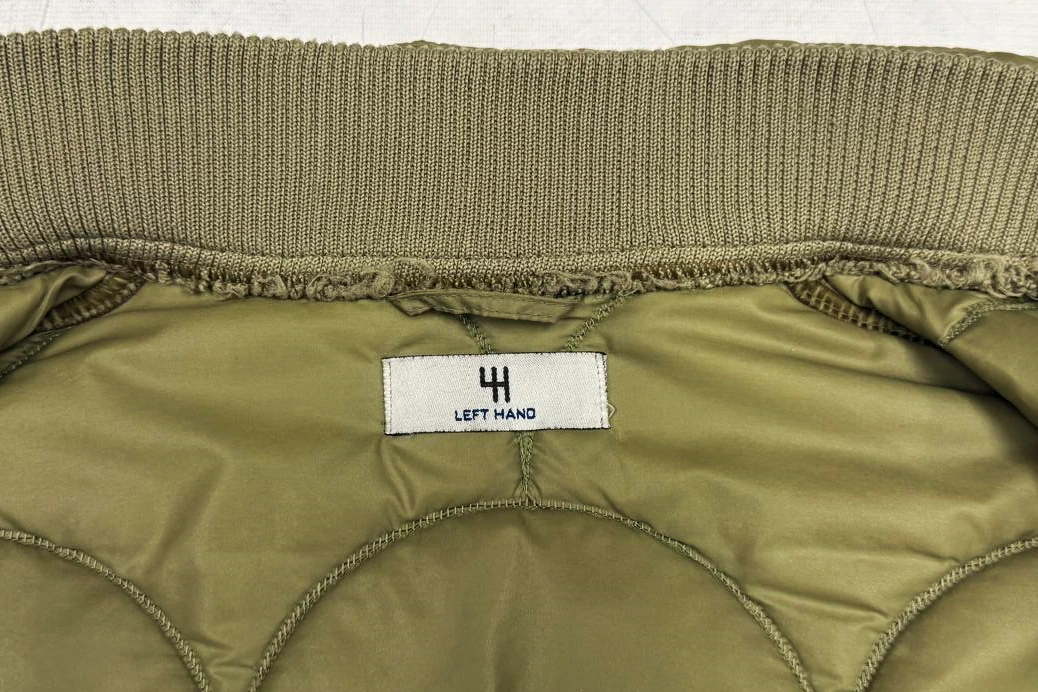
Its condition makes that status clearer. The jacket carries white marks on the left sleeve, soiling around the waistband and hem, fraying along the collar seam, a repaired zip, a small black mark on the right shoulder and pen marks on the right sleeve. In a condition report, these are signs of damage. As evidence, they show use, handling, repair and circulation.
Some marks belong to the garment’s life before the archive. Others were acquired inside it. After the 2019 hire, the condition report records pen marks to the top right sleeve. The damage matters because it shows that preservation does not remove the garment from use. Even as an archival object, the jacket continues to gather traces of the systems that use it.
That continued use is part of why the jacket matters. It was not expensive, rare in any obvious way, or already protected by the status of a menswear grail. Its significance emerged through use: first through the military garments whose logic it reworked, then through Osti’s design method, then through the archive that made it readable, and finally through the later designers who returned to it as material for their own work.
The jacket began by making a hidden layer visible. That was its first transformation. In the archive, it performs a second one. It disappears again, not inside another jacket, but inside the thinking of other designers.
That is why this seemingly unspectacular garment keeps being referenced. It has not simply survived as evidence of Left Hand, Osti, or military influence. The method that produced it is reactivated each time another designer encounters it in the archive.