
The Problem with Paul Harvey
Why the designer gave himself problems nobody asked him to solve.
Republished as originally written. References to events reflect the original publication date.

“I give myself problems.”
Speaking at Pockets in Bath last Thursday, Paul Harvey was describing an approach to design that had shaped his work over the last three decades.
Designers are generally understood as problem-solvers, responding to the demands of materials, manufacturing and the body. Harvey’s approach was different. Rather than waiting for problems to arise, he deliberately created them, imposing constraints that made designing and manufacturing considerably more difficult than they needed to be.
The previous month, at a panel discussion at Central Saint Martins with Carlo Rivetti and Aitor Throup, Harvey described one of his fundamental rules: “No decoration.”
Effectively it meant that anything created for the brand needed to focus on having a functional or constructional justification rather than being applied simply for visual effect.
Harvey’s approach echoes that of Adolf Loos, the Austrian architect and architectural theorist whose highly influential essay, Ornament and Crime, published in 1913, argued against ornamentation, believing it led to a waste of labour and materials. He helped lay the foundations of architectural modernism.
Yet Stone Island’s most visible and recognisable element, the Stone Island compass badge, seems to contradict this approach. Though Harvey did talk about changing the edge from green to black to make it blend in more with the garment, it could still be interpreted as the application of decoration.
Where Harvey differed from Loos was in the extraordinary amount of additional labour he was prepared to undertake to achieve a particular material result.
One of the clearest examples of the problems he gave himself was Pure Metal Shell, produced for Autumn/Winter 1999. It was a reaction to the multiple fabric representatives showing Harvey their new fabrics in which they had woven around 5 percent metal fibre into their fabrics. The result enabled the fabrics to crease and wrinkle. As a reaction, Paul along with Stefano Polato, whom Harvey describes as Stone Island’s production manager at the time, decided “fuck that” and set about producing a jacket using fabric that was 100% steel.
They managed to convince someone to weave the fabric, which Paul said, “was an incredibly stupid thing to do because I think they did tremendous damage to their machines”.
The 100% Pure Metal Shell jackets were always considered by Harvey as a promotional piece that would be put in a shop window, and then inside they would sell that season’s stainless steel coated puffer jackets, which were much more wearable and commercial and wouldn’t wear out.
Instead, Harvey said 1,300 were ordered and put into production, delivered and started to crack and break after they were worn for a couple of days, which he knew would happen. Nearly all of them were returned, and the company still holds 700–800 of them today, which are now used for display and exhibitions.
If the Pure Metal Shell jacket was a problem of material composition, then Compact, a process Harvey developed in 2003, was one of material transformation. It began with a question: could cotton be felted like wool?
While the normal answer would be no, they found that applying the mercerising process to finished garments could make them shrink by 50–70%. The process is normally carried out on the fabric when it’s on a roll.
Mercerising is normally done to cotton fabrics to make them smoother, stronger and more lustrous and better at absorbing dye. It is carried out while the fabric is still on the roll to better control shrinkage as the fabric is under tension.
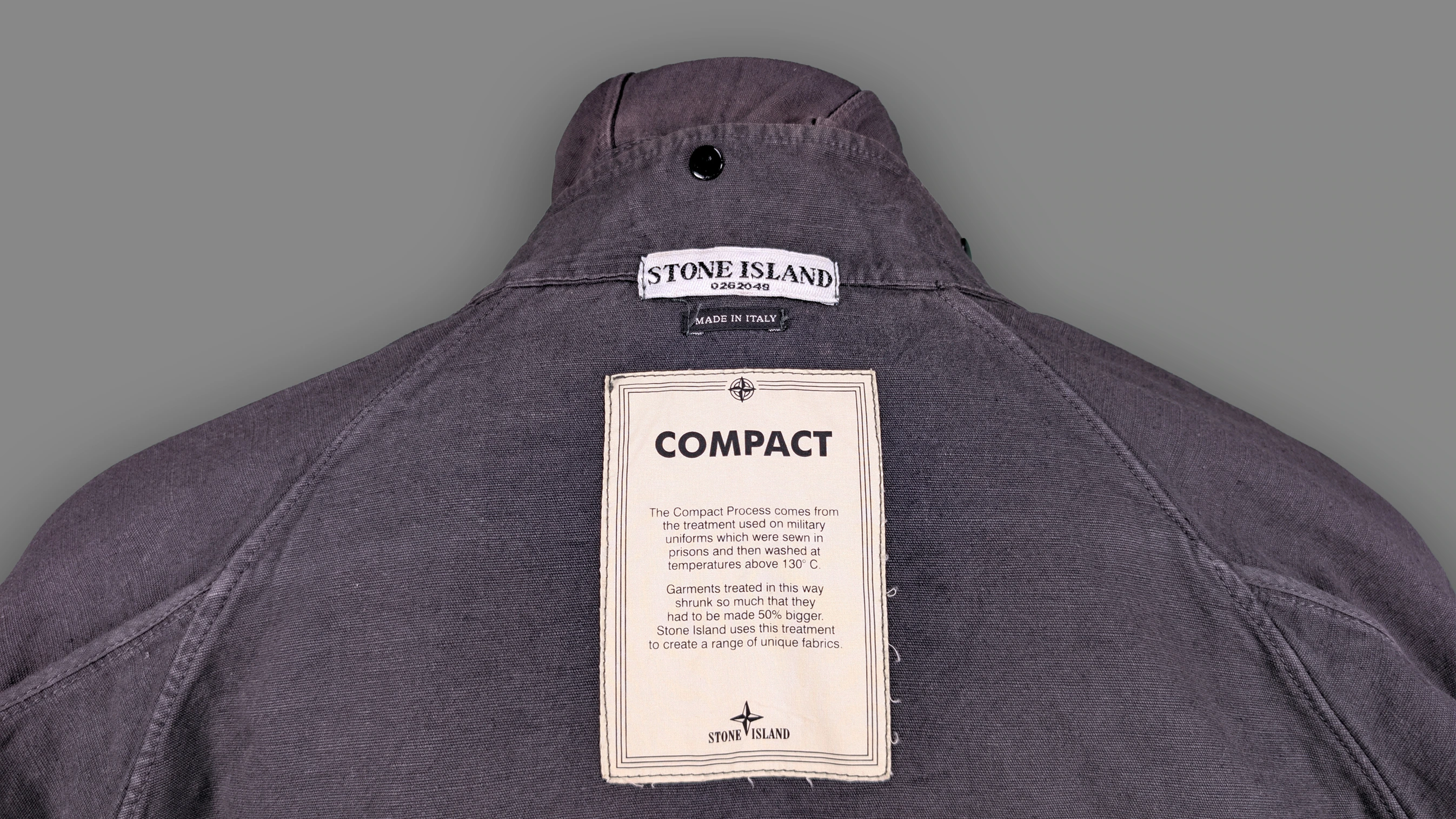
Rather than seeing the shrinking and dimensional instability as a problem to control, he saw the process as an opportunity to inform his design process. Jeans would need to be produced that were almost two metres high before shrinkage, jackets would be produced twice as wide as normal.
By reversing the logic of when and why fabric would be shrunk, Harvey was able to develop an innovative outcome that conventional manufacturers would normally seek to avoid.
“The impediment to action advances action. What stands in the way becomes the way.”
Writing in the second century AD, the Roman emperor and Stoic philosopher Marcus Aurelius was describing how obstacles could be confronted and turned to advantage. For Paul Harvey, they were often something to be deliberately created.
However, it is easy to create a problem. What is much harder is finding the people, resources and approach needed to solve it.
When Harvey arrived at Stone Island, he faced a problem he hadn’t created. He was replacing Massimo Osti, and there was considerable scepticism about whether the English designer could succeed. Harvey recalled being told that people in the industry were betting he would fail. Inside the company, the attitude was much the same: “Let’s see what you can do.”
Yet Harvey acknowledged that the factory Osti had created at Stone Island was an incredible resource. Its strength lay in its manufacturing and production capabilities and, most importantly, its people. They were experienced, demanding and eager to be pushed further. Harvey might have given himself problems, but he needed people who were prepared to make those problems their own. It was this system of material knowledge, technical expertise and a willingness to experiment that enabled Stone Island’s innovation to flourish.
Speaking at Pockets in Bath last month, Harvey explained that any garment produced for Stone Island had to earn the right to carry its compass badge.
Given that his contract was linked to the brand’s commercial success, he could easily have put the badge on T-shirts and sold considerably more. Instead, he recalled how long it took to develop a T-shirt he considered worthy of carrying it.
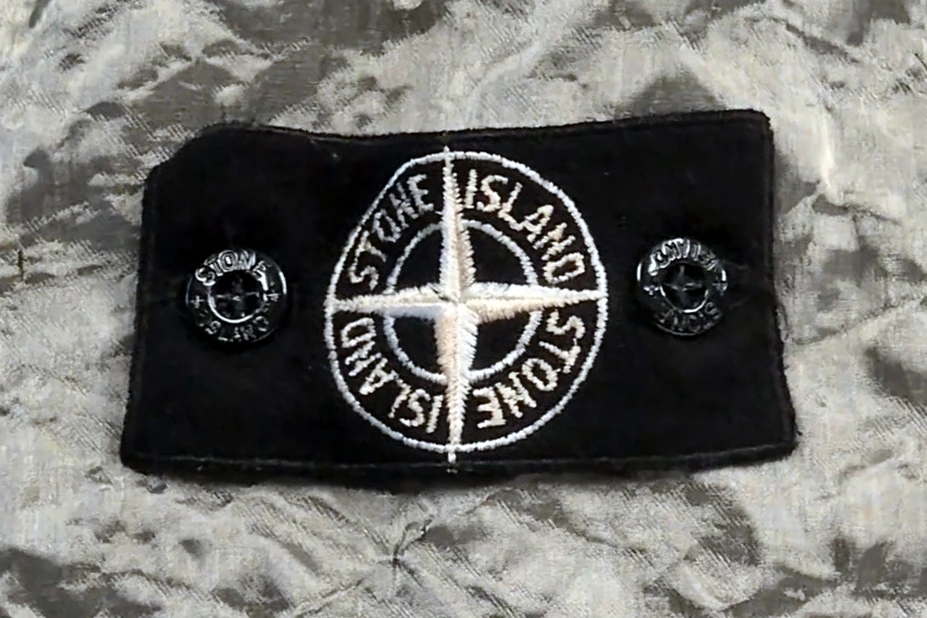
The badge itself might be decorative, but Harvey understood it as something closer to military insignia, a mark of achievement rather than simply an identifying symbol. A soldier has to earn his stripes. For Harvey, a garment had to earn its badge.
Throughout a career spanning more than three decades at brands including Stone Island, C.P. Company and Ten c, Harvey understood that innovation could begin with creating a problem that the factory had never been asked to solve. In doing so, he gave the people in the factory a way to use their accumulated expertise to make clothes differently.
For years, Harvey insisted that his garments earn their recognition. Perhaps the problem with Paul Harvey is that we have yet to give his own career the recognition it has already earned.