
How Resistance Became Methodology in Aitor Throup's Work
Updated: Nov 8, 2025

Next week, Aitor Throup returns to Burnley with his first major retrospective. This exhibition is more than just a showcase of his work. It represents a return to the town where he first faced prejudice and discovered a sense of belonging. Here, resistance evolved from a means of survival into a powerful method.
Turf Moor and the Making of Refusal
Growing up in Burnley, Aitor Throup encountered hostility and racism that marked him as an outsider. Yet, on the terraces of Turf Moor, amidst the noise and ritual of match days, he found a sense of belonging. Football culture provided him with both confrontation and community. It was here that he first encountered the work of Massimo Osti, learning how clothes could serve as armour and signal dissent.
Caught between rejection and defiance, Throup learned to stand his ground. His experience was not abstract; it was physical and embodied. This way of existing became a defiance against the demand to disappear. That stance laid the foundation for his creative practice.

In the realm of fashion, Throup's refusal took on a quieter form. While the industry chased speed, he chose to slow things down. Where others repeated, he reworked. Instead of focusing on spectacle, he developed systems, drawings, and prototypes that resisted quick consumption. Each output joined a longer pursuit, through which an ethos slowly took shape.
From the Moor
His retrospective is titled From the Moor, a phrase that evokes the moorland surrounding Burnley, the open terrain that begins where the terraces end.

The moor can also be interpreted as a liminal space beyond the industrial centre. It offers an escape from the shadows of mills and chimneys, yet it is also exposed and isolating—a place of both release and exclusion. This tension between freedom and marginality runs through Throup's work, where standing outside becomes both a refusal and a position.
There is another history folded into the word "moor." In Shakespeare's Othello, ‘the Moor’ both defines and diminishes its protagonist. It marks him as different and fuels mistrust. In England, it has long been used as a racialised label for those deemed outsiders.
For Throup, growing up in Burnley as an Argentinian immigrant, the term carries its own weight. Instead of accepting that sense of otherness, he transformed it into the foundation of his vision.
To call the retrospective From the Moor is to weave these threads together: geography, position, and race. It roots his practice in the same ground where he first felt the weight of exclusion, turning it into a stage for return.
Presented at the Burnley Empire Theatre, Throup describes the exhibition as a deep dive into work long left unexplained—an attempt to make legible the ethos that has always driven him.

Throup's projects have always been metaphorical narratives, ways of working through experiences of exclusion and conflict. In When Football Hooligans Become Hindu Gods (2006), he reimagined a racist attack as a story of transformation and remorse. In The Funeral of New Orleans (2007), he used marching-band musicians to reflect on race and neglect after Hurricane Katrina. Later, On the Effects of Ethnic Stereotyping (2013) addressed the police killing of Jean Charles de Menezes. Across these works, violence becomes visible through design. For Throup, innovation was as metaphorical as it was material, with prototypes testing both design and meaning. This retrospective makes that trajectory explicit, tracing how biography and refusal became methods of creation.

Form as Resistance
Across two decades spanning fashion, film, and performance, the pieces gathered here trace that evolution. Each stage turns narrative into construction: ideas become garments, metaphors become systems. The exhibition reveals how form itself became Throup's language of refusal—precise, procedural, and deeply personal.

When Innovation Was Real
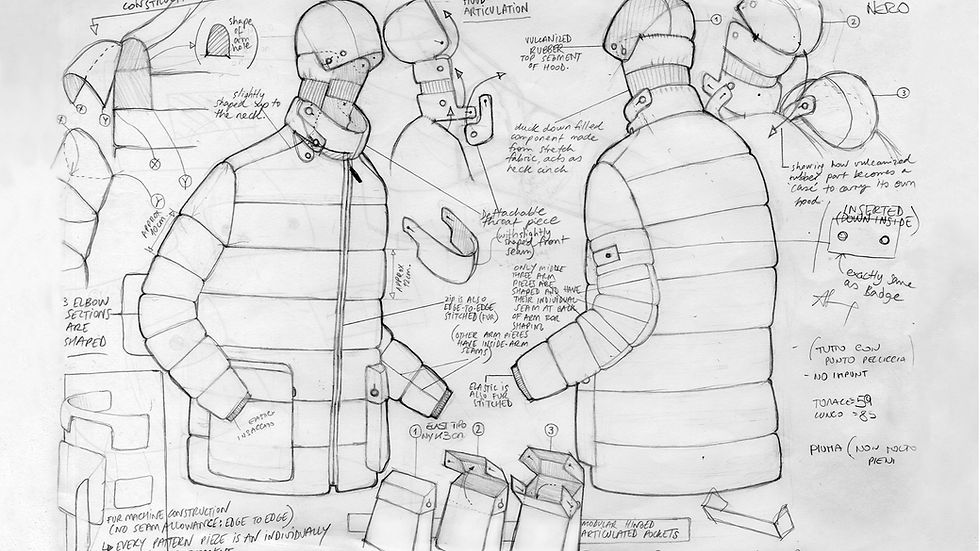
His collaborations with Stone Island and C.P. Company illustrate how that refusal took shape in practice, influencing how he worked with others. Rather than the logo-driven churn typical of brand tie-ins, these one-off projects functioned as prototypes, testing methods and forms that defied scaling or commodification. They allowed Throup to explore what innovation looks like when freed from the system's demands.
From the Moor, Back to Burnley
From the Moor is more than a retrospective. It represents a return to Burnley, where exclusion first tried to define him; to the terraces, where refusal became physical; to the moors—the liminal boundary between the industrial and the elemental.
Throup has described his work as a way of processing trauma, turning lived experience into metaphor. In the end, his return to Burnley becomes another act of construction—not to find resolution, but to approach understanding.

From the Moor runs as part of the British Textile Biennial 2025. Find out more here: britishtextilebiennial.co.uk/events/aitor-throup-from-the-moor
The Impact of Throup's Work
Aitor Throup's work transcends mere fashion. It challenges societal norms and invites us to reconsider our perceptions of identity and belonging. His journey from Burnley to the global stage illustrates the power of resilience and creativity.
Through his retrospective, we gain insight into how resistance can shape not only personal narratives but also broader cultural conversations. Throup's ability to transform experiences of exclusion into innovative design serves as a reminder of the importance of storytelling in fashion.
Conclusion
In conclusion, Aitor Throup's From the Moor is a profound exploration of identity, resistance, and creativity. It invites us to reflect on our own experiences and the ways in which we navigate the complexities of belonging. As we engage with his work, we are reminded that fashion is not just about clothing; it is a powerful medium for expressing our truths and challenging the status quo.



Comments