
Lamppost Loyal: Football Stickers and the Making of Belonging

Most people never notice them. The small vinyl stickers layered on lampposts, stuck on bus shelters or plastered above the piss stones in the pub toilet. But once you start looking, they’re everywhere, a parallel record of football culture that doesn’t appear in official histories or club museums.
Over the past decade I’ve been photographing them, documenting a graphic language of belonging, rivalry, and identity. These stickers feature everything from club crests and slogans to political messages and parody logos, but I’m most interested in those that mirror casual culture itself, taking the brands worn on the body and pushing them out into the city. Pasted in public spaces, they reproduce a distinctly masculine code of visibility and control, turning the city into a contested landscape of territory and belonging.

Most use humour that’s crude, clever, and self-aware; part terrace wit, part graphic parody. They mock the seriousness of brands while celebrating their own. Yet beneath that humour lies something deliberate. The same logos and references recur across cities. What starts as a joke begins to work like a code, reiterated by those in the know.
These stickers echo the earlier calling cards produced by football firms; graphic marks of territory and threat, but their language has evolved with the cultures around them. What were once graphically crude and openly violent warnings are now Photoshopped collages, merging club emblems with the logos of adidas, Stone Island, or C.P. Company. The same markers once confined to clothing now circulate through the built environment, extending identity from the body to the city.
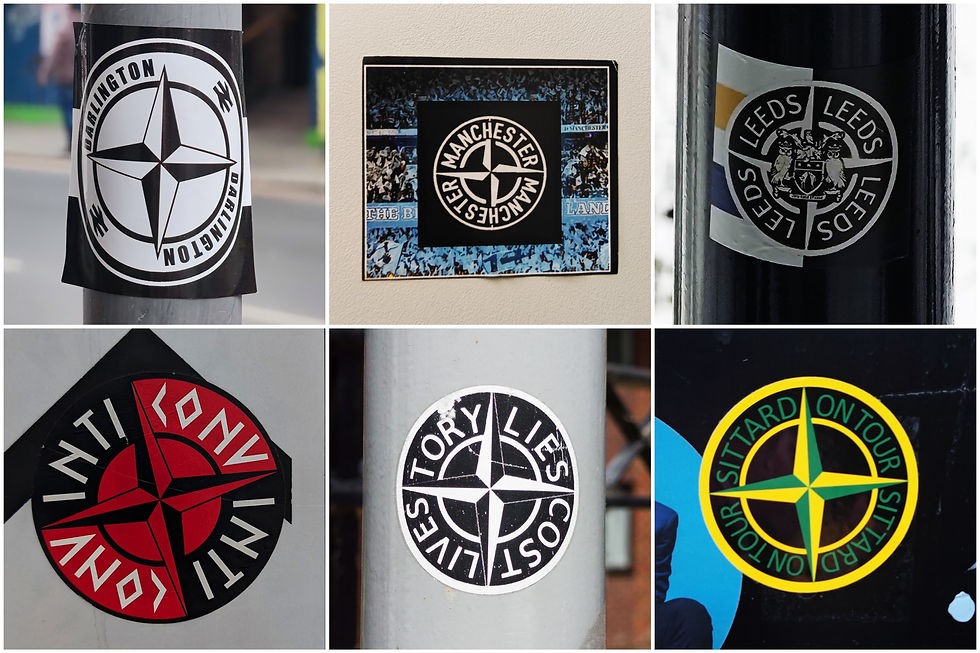
This transformation mirrors the changing economies of football and fashion alike. As clubs and designers have become global brands, their value now rests on projecting authenticity while controlling the risks that real expression brings. Supporters are redefined as consumers; participation becomes performance within tightly controlled systems of visibility.
In this context, these stickers operate as a minor act of resistance. They restore authorship to the crowd, asserting local presence against corporate neutrality. Inside stadiums, surveillance technologies regulate visibility and expression. Outside, the sticker sidesteps that control; cheap, fast, and anonymous, they claim public space as their own.

Yet their use of humour is also strategic. Fans understand the grammar of menswear branding, the three stripes, the compass, the goggle lens, and repurpose them to speak their own code. The adidas stripes shift from trademark to signifier of shared identity; the Stone Island compass detaches from its sleeve and is reoriented towards club, city, or cause; the C.P. Company goggle morphs into a faceless emblem of collective anonymity. Symbols once tied to aspiration are recharged as expressions of defiance, often by twisting the language of class and taste.

A Burberry check framing the words Vile Animals Leeds collapses the line between luxury and vulgarity. Both the pattern and the insult are reclaimed, the symbol of privilege and the slur of exclusion turned back on themselves. Within a few square centimetres, the sticker folds together humour, defiance, and class antagonism; it’s a miniature study in how dense this visual language can be. What the tabloids once used to mark shame is reworked as pride, an inversion where insult becomes a badge of honour.
Such doubling, parody and possession sit at the heart of this culture. The Vile Animals Leeds sticker isn’t an outlier but a model: authority mocked and appropriated in the same gesture. These designs mimic power to expose it, turning commercial symbols into tools of autonomy. The fan who pastes an Adidas trefoil beside his club crest isn’t rejecting the brand; he’s reclaiming its authorship, insisting that meaning belongs to those who live it, not those who sell it.
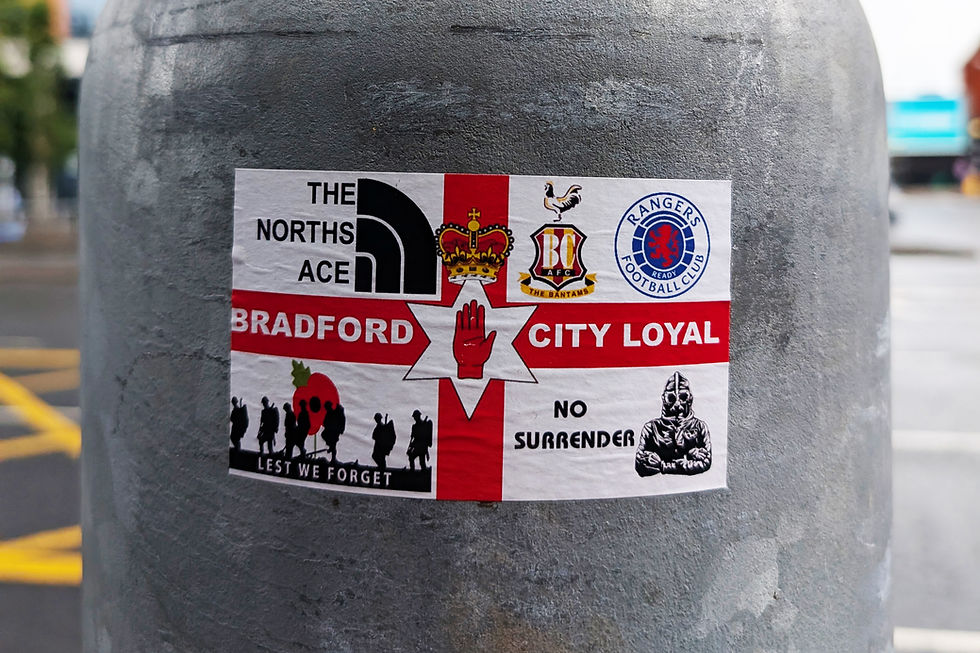
That dynamic reaches its clearest expression in a single sticker. Bradford City Loyal appears, at first, to be another act of wordplay, The Norths Ace replacing The North Face. Yet surrounding the parody cluster are a crown, a poppy, the Red Hand of Ulster, and the phrase No Surrender. Bradford’s crest sits beside Rangers’, collapsing geography, politics, and history into one visual field. What begins as terrace humour concludes as coded allegiance. Global branding becomes a vessel for local identity, nationalism, and collective memory.
Loyalty threads through every layer — to club, brand, and nation — each promising belonging while competing for dominance. The sticker compresses those rival claims into a few centimetres of print, where decoration becomes negotiation between parody and pride, between identity imposed and identity reclaimed.
What they also reveal is how fragile loyalty has become. Football used to offer a place for it, but as clubs turned into global corporations and branded lifestyles, that sense of belonging slipped away. You can still buy the kit, wear the badge, show your colours — but it doesn’t mean the same thing. The same drift can be felt beyond football, as national symbols lose conviction and collective pride gives way to managed identity.
These stickers feel like what’s left of that instinct, a way of saying we’re still here, even if no one’s noticing. They’re not about nostalgia so much as persistence; a need to claim space in the few places left that still feel like theirs.
On lampposts, bus shelters, and above the piss stones in the pub toilet.


Comments