
The Discipline and Devotion of Craig Green
- Dec 11, 2025
- 4 min read
What labour do you endure?
What structure do you uphold?
What weight do you bear?
Labour

Craig Green’s work begins with effort. Labour, for Green, is not the production of clothes but the slow, exacting work of secular belief. From his earliest collections, he has asked what the body can withstand, and how the act of wearing can become an act of endurance. The sculptural forms of his 2012 Central Saint Martin’s show were not props but burdens; structures that made visible the weight of creation itself.
By the following year, those burdens had hardened: jagged wooden frames engulfed the head and shoulders, turning models into half-effigies, half-martyrs. The body was still central, but now half-erased, protection and exposure collapsed into a single gesture. What began as an experiment in making became a test of being; the labour of fashion turned into the labour of endurance.
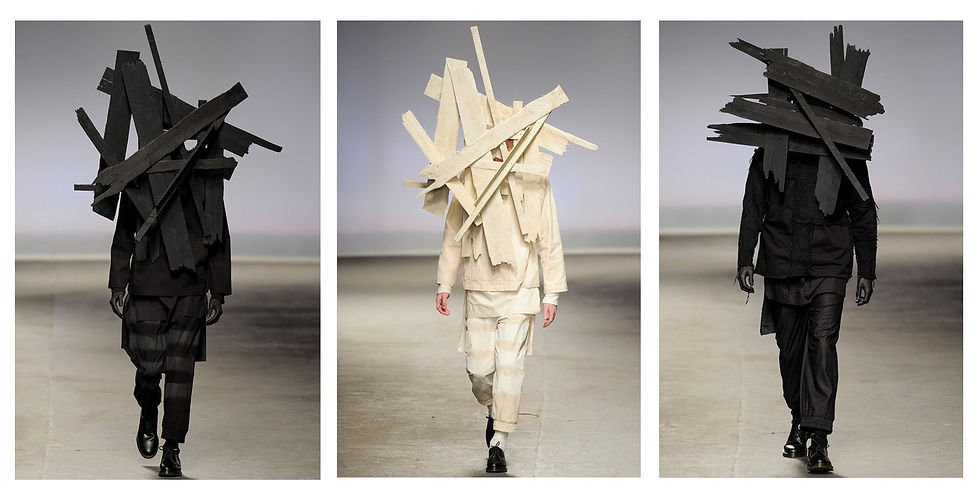
His models don’t perform; they persevere. The runway becomes a site of trial, the garments a measure of conviction. This labour is not punishment but proof — the shared effort that binds maker, wearer, and viewer into the same moral geometry. It recalls both the soldier drilled into readiness and the novice repeating the same rite every day, each believing that meaning lies in the act itself. What unites them is devotion: the faith that the repetition and order of labour can still create meaning.
Structure

If labour is Green’s creation, then structure is his creed. He treats fabric as a system rather than a surface, something that holds tension, enforces rhythm, and gives the body an architecture to live within. His precision carries a moral clarity. Every seam, cord, and closure insists that the discipline of the body can be a form of care, that alignment itself can be a kind of grace.
The military sits quietly beneath this logic. Much of menswear’s devotion to line, balance, and rigour comes from the parade ground, where control is the measure of masculinity. Yet within that military order stands the chaplain, wearing the same uniform but offering a different kind of order, one that demands reflection rather than obedience. Green’s work occupies the space between those two figures: the sergeant who sculpts the body into readiness and the chaplain who steadies it to endure; a practice balanced between control and compassion, precision and humility.

His fascination with the gig line — that strict vertical alignment of shirt placket, belt buckle, and trouser fly — captures this perfectly. In military dress, the gig line disciplines the body into visual order; in Green’s hands, it becomes a devotional axis, a seam of belief running through the body’s centre. The wearer stands upright because design requires it. The straight line becomes a moral one.
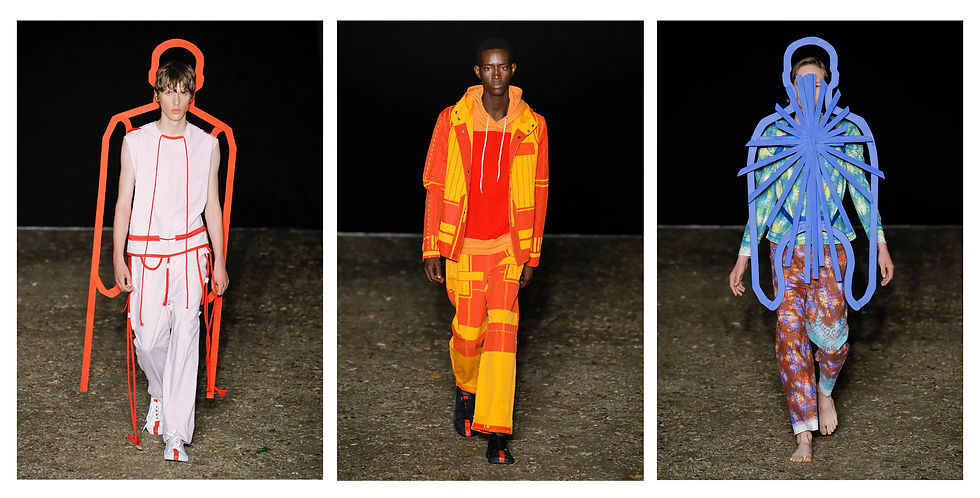
Over time, that geometry grew outward, becoming architecture: frames that enclosed the body not as punishment but as form.
Across his work, these structures don’t impose suffering; they reveal endurance. The posture they demand is one of openness under strain, a willingness to be held. Through these forms, Green shapes clothing into a practice of order, a philosophy of the body built on balance, tension, and restraint.
Weight
If labour creates and structure holds, then weight gives meaning. It is what remains once motion stops; the quiet pressure of significance resting on the body. Green’s garments have always carried this sense of moral gravity. The quilted, padded, and strapped pieces of Autumn/Winter 2015 made that weight visible as protection, while the translucent technical fabrics of Spring/Summer 2026 suggested something lighter: the possibility that belief, once carried, could become grace. The weight was no longer external; it had been absorbed. Across these shifts, the same question persists — how much can a garment bear before it collapses under its own intent?

Weight, in Green’s world, is more than material. It is emotional, ethical, and collective. His clothes make responsibility visible. To wear them is to participate in a shared endurance, to accept the visible labour of care. His runways unfold less as shows than as processions, rejecting fashion’s obsession with spectacle. They move with quiet conviction; the effect is not theatrical but liturgical, a secular ritual enacted through movement, cloth, and restraint. In his hands, the runway becomes a ground for conviction, a temporary space where belief takes form, a momentary alignment before it passes.
The Material Trinity
Craig Green’s work belongs to an age that has lost faith in institutions but not in ritual. What he offers is a secular liturgy — a belief in repetition, in the slow repair of meaning through making. His theology is material, fashioning belief out of fabric and form rather than doctrine or myth. Labour becomes devotion; structure becomes faith; weight becomes grace. His men are not redeemed by beauty or display but by endurance — by standing straight, holding balance, and bearing the consequences of order.

We are living through a quiet return to belief. The search is for conviction rather than doctrine, for the steadiness of ritual when institutions feel hollow. Green’s work moves in parallel: a faith built from the small acts of making, mending, and carrying on. Through repetition and attention, he rebuilds a language of conviction that belongs to neither church nor regiment, but to the body itself.
Green's work ends where it began; in discipline, in belief, in the body.
What labour do you endure?
What structure do you uphold?
What weight do you bear?

Comments