
The Most Contested Wall in British Menswear
Updated: Oct 12, 2025
How a chip shop outside Manchester's Etihad Stadium became the frontline for fashion, football, and working-class identity

As the Premier League season kicks off, all eyes return to the Etihad Stadium in Manchester. But just across the road, something else is vying for attention, a squat, white-painted chip shop that has, season after season, become one of the most hotly contested sites in British menswear.
This isn’t just about murals. It’s about who gets to shape football’s visual culture. About what kind of masculinity gets projected. And who owns the narrative of the working-class football fan.
The Wall That Never Stays the Same
On the corner of Ashton New Road, beneath a sign that simply reads FISH & CHIPS, the gable end of the Maine Road Chippy has become an unofficial billboard for brands looking to stake a claim to Manchester’s footballing soul. Its proximity to the Etihad makes it prime real estate, but it’s not about footfall, it's about optics. The wall doesn’t sell chips. It sells identity.

Puma were first to mark the wall, using it to launch Manchester City’s 2023/24 home jersey. With Ederson, Chloe Kelly, and Jack Grealish handing out fish and chips, the mural tried to collapse the distance between players and punters, serving banter with branding. But beneath the cheeky smiles and golden fries, it was a tightly managed image reset: a global club trying to localise itself, one chip at a time.

Stone Island followed in November 2024, staking its claim with a mural that felt like a flag. Liam Gallagher, dressed in a shimmering Glass Cover-TC jacket, stared straight ahead, expressionless, rooted. The compass badge was perfectly visible. This wasn’t just a brand placement; it was cultural reinforcement. A declaration that, in Manchester, Stone Island isn’t just worn. It’s inherited.
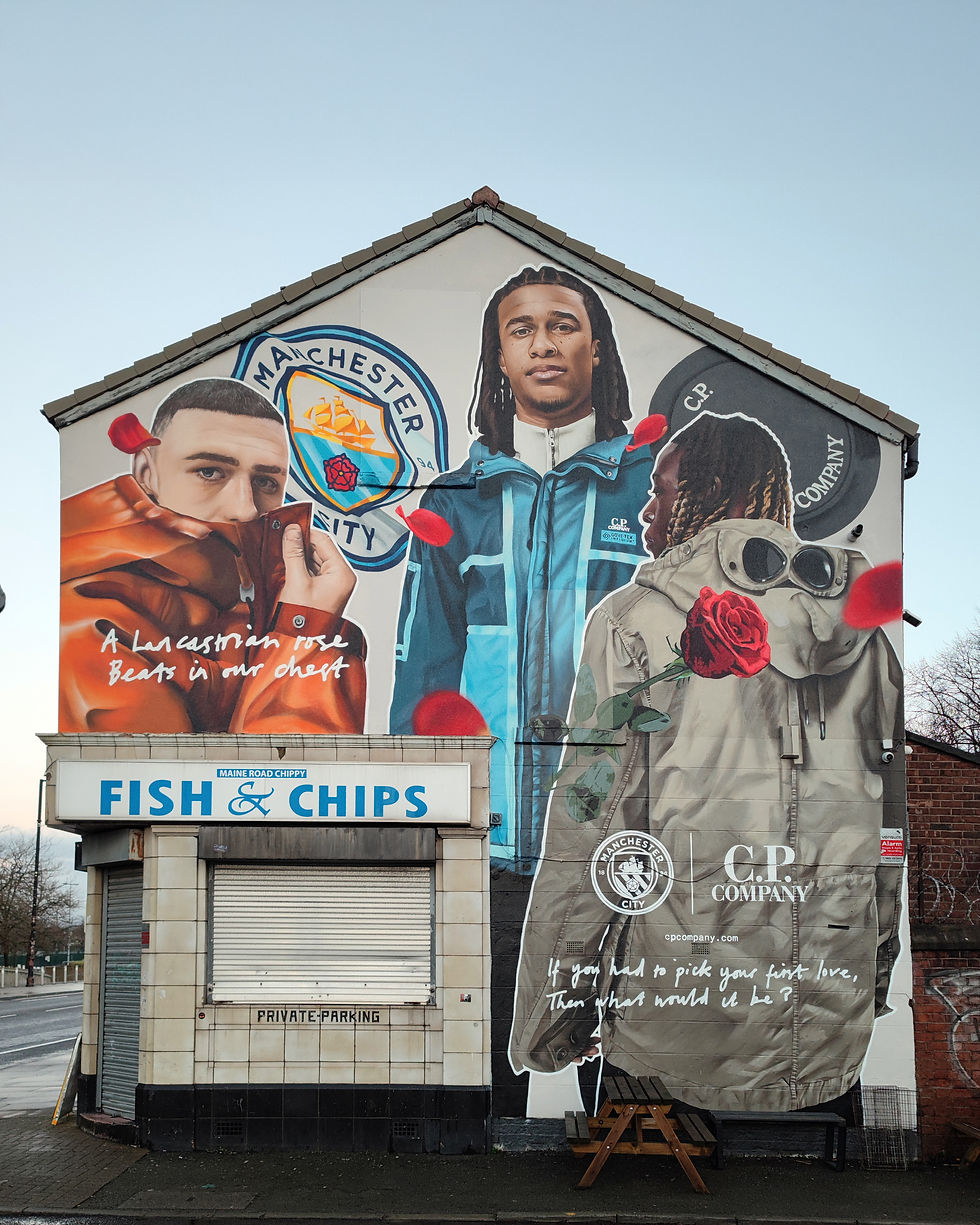
In January 2025, C.P. Company took a different route, softer, more emotional. Red rose petals floated around figures in iconic Mille Miglia jackets, evoking both Mancunian pride and terrace nostalgia. With slogans like "If you had to pick your first love, then what would it be?", it leaned into sentiment, wrapping subcultural memory in post-industrial romance. Less posture, more feeling.
Lidl by Lidl, July 2025. Post-ironic branding joins the casuals.
Then came Lidl in July 2025, and the message shifted again. Their mural featured a model in Lidl-branded technical outerwear, styled with the proportions and finish of a Berghaus jacket. It wasn’t parody. It was intent. A supermarket brand adopting the visual language of British outdoor gear, not to mock it, but to claim its relevance. Where C.P. Company and Stone Island gesture to legacy, Lidl offers immediacy. Affordable, functional, recognisable. It’s a different kind of uniform, rooted not in rarity but reach.
Each mural overwrites the last. Nothing stays long. The wall gets whitewashed, rebranded, retargeted. It’s marketing by palimpsest, layers of meaning, class politics, and brand identity fighting for space.
Why This Wall Matters
This chip shop isn’t just a wall. It’s a battleground.
It’s where fashion, fandom, and the politics of place collide. For brands like Stone Island and C.P. Company, this wall connects them directly to the terraces, to a time when wearing these labels was an act of belonging or defiance. For newer players like Lidl, it’s an ironic nod to that same history, refracted through post-ironic branding.
And when the football club itself steps in with a mural, it feels almost like a turf war. Manchester City, now globalised and hyper-commercialised, attempting to fold back in a sense of local identity. Fish and chips. Cheeky smiles. But it’s stylised. Controlled. Designed for social media, not the street.
What’s at Stake This Season
As City fans return for another campaign, the wall outside the chippy will likely change again. What’s painted there isn’t just marketing. It’s a weather vane for how menswear, masculinity, and working-class culture are being repackaged and sold back to us.
So this season, when you walk past that wall, ask yourself:
Who’s being represented?
Who’s being sold to?
And who’s quietly being pushed out of the picture?
Because while the match happens inside the Etihad, the real culture war might just be happening on the wall next door.

Comments