
Masonic Regalia: How Meaning Holds
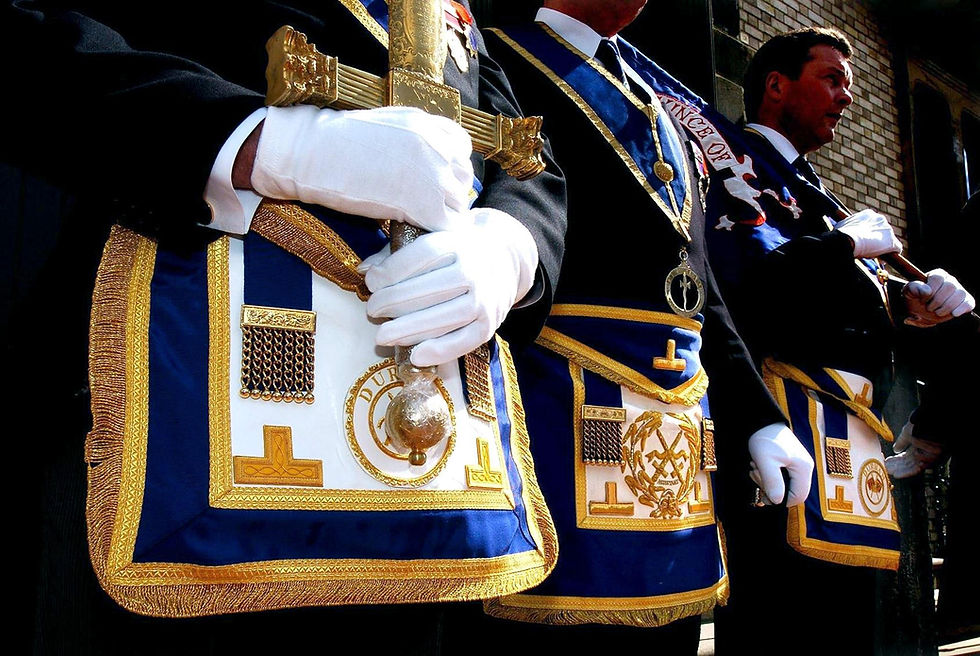
Most people misread Masonic regalia as decorative, as a ceremonial display of aprons, collars, and metal jewels, even though each element has a specific function. What appears ornamental is in fact organised information that fixes meaning through role, rank, and position, turning dress into a system. Though I am not a Freemason, it is the clarity of that system that fascinates me.
To read Masonic dress, you start with the common ground. In English Craft Freemasonry, that means black suit, white shirt, tie, and black shoes. This is not a matter of taste. It suppresses individual variation and establishes a uniform baseline from which difference can be read clearly. This is not where distinction is marked; it is what makes the system legible, providing the ground on which the regalia can operate.

The apron is the most visible element, and the first point at which rank enters the system. Worn at the waist, and derived from the stonemason’s lambskin apron, it indicates degree: the stage a Mason has reached within the lodge. In English Craft Freemasonry there are three degrees: Entered Apprentice, Fellow Craft, and Master Mason.

The Entered Apprentice wears the apron in its simplest plain white form. The Fellow Craft’s apron adds further detail, while the Master Mason’s is more elaborate again, typically marked by coloured edging and three rosettes. The apron does not decorate the body; it records a progression through the degrees.
Above it sits the collar. Worn around the neck, it forms part of office regalia rather than degree. Suspended from it is the jewel, a metal emblem that identifies a Mason’s office more precisely. Together, they make present office legible, showing not how far a Mason has progressed, but what role he holds within the lodge.

Other jewels are worn elsewhere. Pinned to the left breast of the jacket, like medals, these breast jewels indicate past office, service, or affiliation. They mark not present office, but prior service and institutional connection.
Each element carries different information. The apron marks progression; the collar and its jewel indicate present office; breast jewels indicate past service or affiliation. Read together, they organise time on the body. Progression, office, and record are held apart and made legible at once.
This system works because it is stable. Its meanings hold because its rules hold. The distinctions between degree, office, and service are not constantly revised, reinterpreted, or aestheticised; they are maintained. That stability allows the system to function with precision.

This places it at odds with the dominant logic of contemporary fashion, where meaning is produced through endless change. It depends on novelty, turnover, and obsolescence. Menswear, in many of its functional forms, works differently. It often derives authority through continuity. Meaning is not produced by replacement, but preserved through repetition.
Ceremonial dress makes this especially clear. These systems begin as function, organising bodies, establishing rank, and regulating behaviour. Over time, function becomes rule. Repeated, enforced, and transmitted across generations, the system stabilises. Their meanings do not drift because the structure that produces them remains intact.
Masonic regalia is an unusually clear example of how ceremonial dress retains meaning over time. The formal dress remains fixed, while the regalia layered onto it keeps degree, office, and service clearly distinct. Their meanings remain stable and legible. It has not been subjected to the same processes of loosening, borrowing, and reinterpretation that have affected much contemporary menswear. Its authority accumulates through continuity.
That continuity is not abstract; it is material and social. Regalia is often passed down, from father to son, from one Freemason to another. More importantly, the system itself is transmitted intact. The current wearer does not invent its meaning; he inherits it.

To wear it is to occupy a position within an existing structure. The apron, collar, and jewel do not reveal who the wearer feels himself to be. They assign his place within the lodge. His position is specific, but not unique. Others held it before him; others will hold it after him.
Masonic dress does more than make the present legible; it places the wearer within a sequence that existed before him and will continue after him. Over time, that continuity produces a different kind of power. It lies not in individual expression, but in endurance. It does not need to be constantly restated because it is continuously enacted.
In most contemporary dress, these systems have eroded. Formal dress codes have given way to informal conventions. Signals drift, meanings blur, and interpretation becomes situational and personal. Menswear frequently borrows the appearance of uniform, ceremony, and work without retaining the rules that once made those garments exact. Rank becomes style, function becomes mood, and authority becomes aesthetic.
Masonic dress stands apart because it has not followed that trajectory. Its rules remain fixed and its distinctions intact. In that context, its clarity becomes more noticeable. It does not simply mark belonging; it shows that the system still holds.
What now looks obscure is not the clothing itself, but the rarity of a dress system that still holds meaning this precisely. Most dress no longer does.
Masonic regalia does. It does not ask what the wearer wants to be; it tells the room how he is to be read. Its authority lies not in individuality, but in continuity. The wearer is temporary; the system is not.


Comments