
Menswear and the World It Promised

Before I knew anything about class, status, or style, I knew this: if you wanted to enter a world, you had to be dressed for it. That was the lesson Mr Benn taught me. Every episode began with the same uniform of respectable English stability: jacket, tie, bowler hat, striped trousers. He then stepped into the fancy-dress shop, changed clothes, and found himself somewhere else entirely. A cowboy, a spaceman, a diver, a hunter: the outfit changed, and so did the world. Looking back, it feels less like a children’s cartoon than an early lesson in menswear. Clothes do not just express who you are. They decide where you can go, how you will be read, and what kind of life becomes possible.
What strikes me now is how exact that logic was. Everything depends on what Mr Benn is wearing before anything happens. He is dressed correctly for the City: respectable, conventional, immediately legible. His clothes fix him in place. The jacket, tie, bowler hat, and striped trousers do not make him interesting so much as readable, the figure of a man properly dressed within an ordered world and securely in his place. Nothing in the outfit implies risk, improvisation, or escape. That is why the transformation works. Before anything can change, he must first be stabilised.

But once he gets changed, the terms shift. The costume does not just alter his appearance; it changes what becomes possible. That was the lesson Mr Benn taught me as a child: when you get dressed, you get changed. In the hunter’s jacket, he can move through the jungle as though he belongs there. In the frogman suit, he can enter an underwater world. In the spacesuit, he can step onto another planet and move through it with ease. The clothes do not simply dress him; they change how he is met, what he can do, and what kind of story he is allowed to enter.
That is what Mr Benn understood so well. He cannot improvise his way into these worlds as the man he was before. He has to get changed. The fitting room is a threshold. It makes visible something usually left unspoken: you cannot enter a world unless you are correctly dressed for it.
Most people learn some version of this before they have the words for it. The wrong clothes make things harder. They make you visible in the wrong way. The right clothes reduce friction. They let you pass. Once you learn that as a child, you do not forget it.

You can see the same logic later in British menswear, especially in casual culture, where clothes made for one world are lifted into another: hunting jackets, military gear, technical outerwear, workwear. This is usually described as style, but style does not fully explain the force these garments carry. They come charged with authority, readiness, protection, movement. The outfit comes first, and the behaviour follows.
Workwear and military clothing had long been worn beyond their original purpose, from denim in postwar America to surplus clothing in youth culture. What changes in Britain in the 1970s and 1980s is not their presence but their meaning. As recession takes hold, jobs for life begin to disappear, and mass unemployment reshapes entire regions, the structures that once gave men stability, routine, and place begin to weaken. Clothes associated with work still looked solid, competent, and dependable, but the world that had once made those qualities believable was starting to come apart.
Under those conditions, clothes associated with work, competence, and routine acquired a new charge. They no longer simply reflected working life. They began to compensate for its loss. Stability was weakening, but its visual codes endured. Menswear continued to offer the look of authority, control, and readiness long after the structures that had once made them believable had begun to break apart. If anything, those promises only grew more attractive. The clothes still let men look prepared, grounded, and in place, even when the world that had once made that feeling possible was slipping away.

Massimo Osti understood that perfectly. He did not invent military, industrial, or technical clothing, but he recognised what those garments had come to mean. He brought into everyday menswear the authority of clothes shaped by work, discipline, and use. What he sold was not just utility, but the look of competence: readiness, protection, control. His clothes felt less like fashion than equipment. They gave men access to the signs of function at exactly the moment when work, class, and identity were becoming less secure. Modern menswear would draw its power not from stability itself, but from the appearance of stability. Mr Benn turned that logic into a children’s story. Osti turned it into a wardrobe.
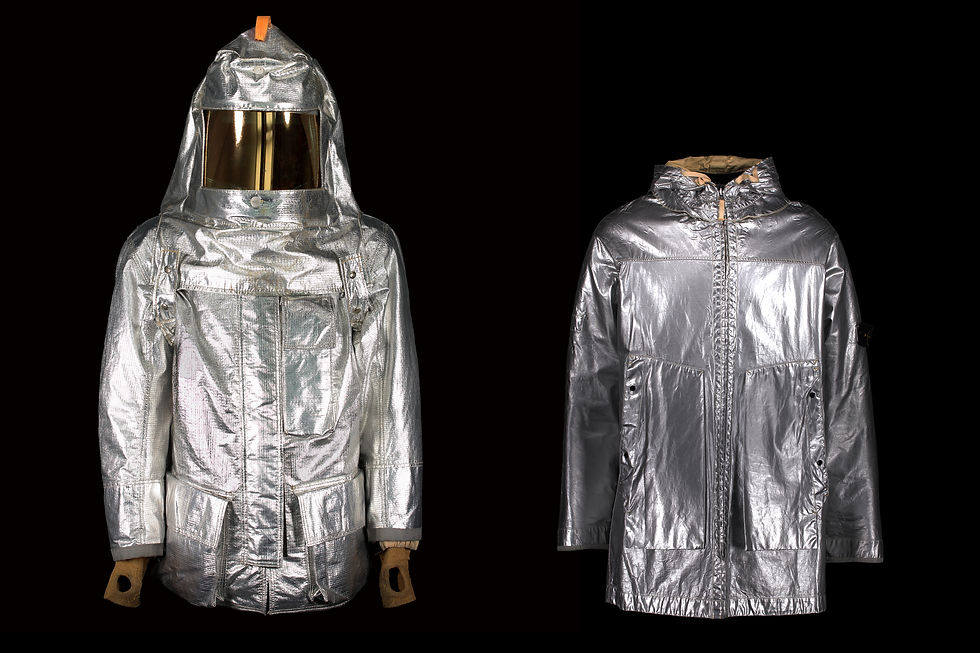
Looking back, Mr Benn captured something larger than a children’s cartoon. Clothes do not simply prepare you for the world. They help decide which world you are allowed to enter. For much of the twentieth century, menswear also seemed to connect men to a stable role within that world. That is why menswear still carries so much weight. We keep dressing for recognition, authority, and belonging long after the structures that once guaranteed them have weakened. The trouble is that the world those clothes once seemed to grant access to has gone.
What remains is the belief that dressing correctly might still be enough to bring that world back.
Mr Benn images: created by David McKee, produced by David McKee Productions (1971–72)

Comments